The Limbu
History
From office-holding at the Vijayapur court, through the Gorkha conquest and the agreement of 1774, to kipat’s abolition in 1968 and the disputes still open today.
Limbu history is usually told as a single arc from independence to loss. The documents support something more interesting: a people who held real office in the polities around them, negotiated a settlement with the Gorkha state that was written down, held land under a tenure no other Nepali community had, and lost that tenure to an amendment most accounts misdate.
Vijayapur and the Sen kings
Before Gorkha, the political frame of the eastern hills and the adjacent Tarai was the Sen kingdoms. The Makwanpur line was founded in 1518 by Mukunda Sen, descended from a branch of the Bengal Sena dynasty that had settled at Rupanagar in modern Saptari district in the first half of the thirteenth century; Hariharsena ruled 1631–1672; and under Mukunda Sen II the kingdom fragmented into Palpa, Vijayapur and other principalities Das, Basudevlal 2014 B.
Vijayapur is the polity that matters most for Limbuwan. Raja Ram Subedi’s study records it as founded by “Kotche King Sangla Ing,” with seven Kotche rulers down to Vijaya Narayan Roy, and then passing to Lohang Sen of Palpa in the mid-seventeenth century, who governed partly through copper-plate charters to Kirata chiefs Subedi, Raja Ram B.
The politically significant detail, drawn by Subedi from Francis Hamilton’s An Account of the Kingdom of Nepal (1819), is that Vijaya Narayan Roy “made an alliance with Morey Hang, a chieftain of the Kirata, and appointed him as the minister (Dewan)” — and that the ministerial office rotated, holders being “given the title of minister for six months in the rotation basis” Subedi, Raja Ram B.
Limbu chiefs held real administrative office at the Vijayapur court, not merely tributary status. That is a meaningful correction to any account which treats Limbus as purely peripheral before 1774.
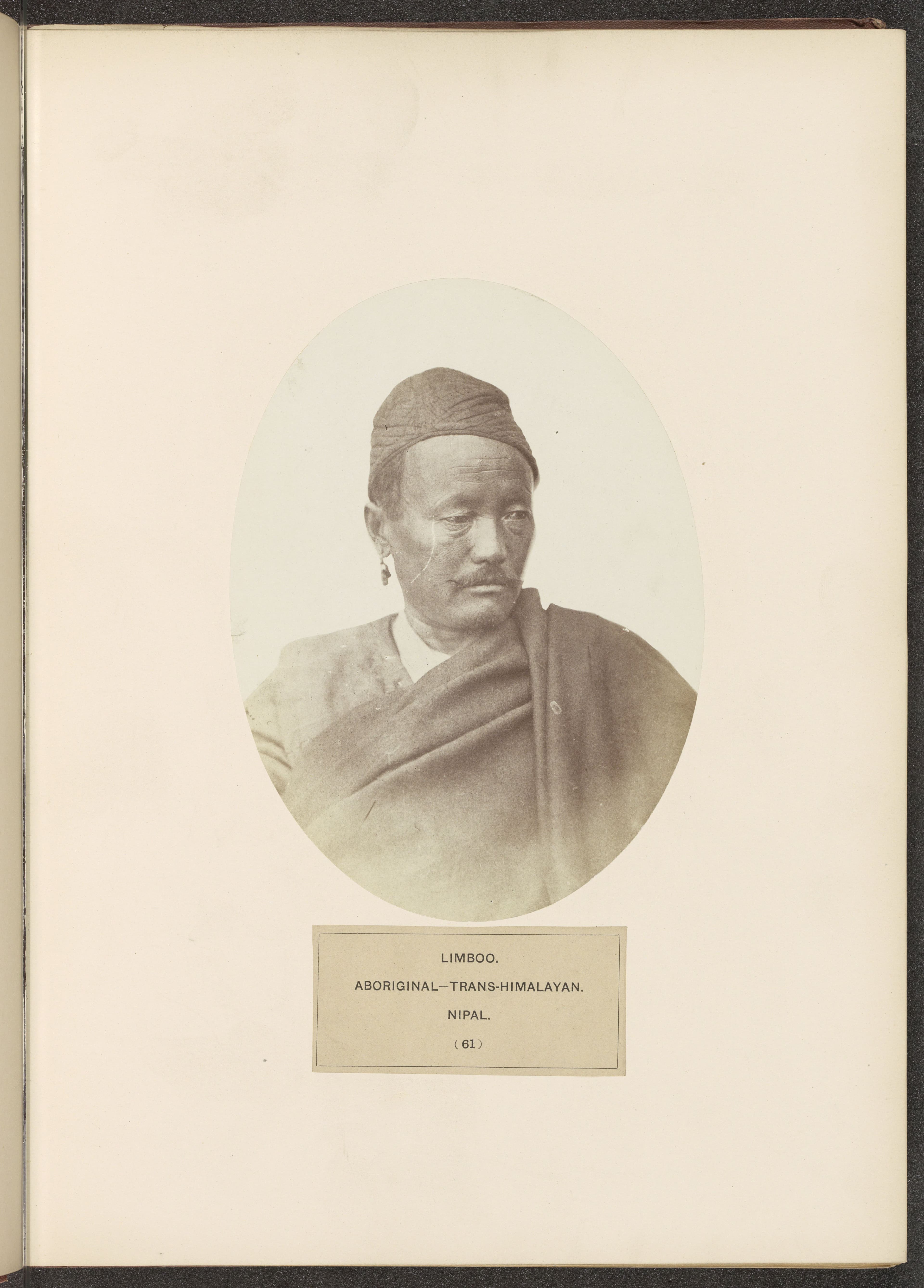
A Limbu man in Nepal, photographed around 1858–1868 and preserved as an albumen-print page by the Rijksmuseum. The colonial-era wording visible in the source scan is historical metadata, not this site’s terminology; the sitter is not identified as a Ninglekhu/ku ancestor.
,_RP-F-2001-7-1122B-6.jpg)
Contested
When did Sen rule over Vijayapur begin?
The gap is forty to a hundred years, and this project could not resolve it.
Subedi, following Chemjong and Hamilton
BSen control from the mid-sixteenth century; a “unified period” of 1553–1775 Subedi, Raja Ram.
Popular chronologies
ESen control from 1608–09, when “King Lohang Sen of Makwanpur with the help of the Kirant force conquered Bijaypur” Ninglekhu/ku heritage documentation project 2026.
The Gorkha conquest
Prithvi Narayan Shah took Makwanpur, the Sen seat, in 1762. Gorkha forces crossed into Limbuwan around 1771, after subduing Majh Kirat Ninglekhu/ku heritage documentation project 2026 B. Fighting is recorded at Chainpur, Majuwa, Kulum, Dingla and Pauwa (1773) under the commanders Ram Krishna Kuwar and Abhiman Singh Basnet. Limbu commanders named in tradition include Sanbotrey, Tesakpa, Kangkarey and Kangso, with a single-combat episode at Chainpur and a ceasefire brokered by the Sikkimese king Tenzin Namgyal Ninglekhu/ku heritage documentation project 2026 E.
Negative finding
EThe rest of that paragraph is Grade E
The battle sites, the named commanders, the single combat and the brokered ceasefire come from blog compilations with no primary citation. So do the casualty figures and the frequently repeated claim that 32,000 Limbus fled to Sikkim, Bhutan and Assam. None could be traced to Pradhan, Regmi or Stiller. They may be true; they are not evidenced Ninglekhu/ku heritage documentation project 2026.
A further complication: one Tribhuvan University thesis states that “Limbus fought with Gurkhas for twelve years,” against the standard three-year framing of 1771–1774 Tribhuvan University e-library theses on Limbu ritual specialists and Limbu folklore.
The agreement of 1774
The best-attested wording available anywhere in this project comes through Dambar Chemjong’s Cornell dissertation, which cites Regmi (1978:626) and Iman Singh Chemjong (1957) for the text of Prithvi Narayan Shah’s 1774 decree Chemjong, Dambar Dhoj 2017 Regmi, Mahesh Chandra B:
We desire peace and harmony. Our intent is good. We hereby pardon all of your crimes and confirm the customs and traditions, rights and privileges of your country. Join our nobles and render them assistance. Take care of the land as you did when it was being ruled over by your own chieftains. Enjoy the land from generation to generation as long as it remains in existence. — Prithvi Narayan Shah, 1774, cited in Chemjong 2017 after Regmi 1978:626
Grade B is the citation chain. Grade A would require the Regmi volume itself, which could not be opened.
| Claim | Grade | Source | Note |
|---|---|---|---|
| Recognition of kipat land rights. | B | Chemjong 2017 | Corroborated by the decree text and assumed as background throughout the scholarly literature. |
| Internal self-rule for Limbu chiefs (Subbas) under Gorkha suzerainty. | B | Chemjong 2017 | |
| A mutual oath sworn on salt and water — the Nun-Pani ko Sandhi, in which betrayal invites a curse symbolised by salt dissolving in water. | E | Ninglekhu/ku heritage documentation project 2026 | Popular tradition. The wording circulating online could not be traced to a primary document in this project. |
| Acknowledgement of the Shah king as suzerain, with military support on demand. | B | Chemjong 2017 |
Contested
What the 1774 agreement means
The community and autonomy account
CThe agreement is a live political document, not an antiquarian curiosity: the Federal Limbuwan State Council’s claim is precisely that Kathmandu has breached “a treaty for autonomy dating back to antiquity” Chemjong, Dambar Dhoj 2017.
The critical reading
CThe transmission history is not clean: the treaty’s “authenticity has been questioned for potential post-hoc alterations by either side to suit political agendas, with no comprehensive archival analysis resolving discrepancies.” Critical readers also note that later interpretations sometimes read the agreement as proof of enduring independence while “overlooking clauses subordinating local rulers to the Shah monarchy” Ninglekhu/ku heritage documentation project 2026.
Dambar Chemjong’s own framing is the model this site follows. He describes the document as “considered by the Limbus, as the treaty between the Gorkha Hindu King and the Limbu Chiefs” — naming it explicitly as a community understanding of the event — and argues that “there cannot be a singular history of Nepal. Rather there are multiple histories.” That is not evasion; it is the correct historiographical description of a document whose meaning has always been contested Chemjong, Dambar Dhoj 2017 B.
The settlement also did not end resistance. An uprising at Chainpur/Siddhipur in 1791–92, led by Ruddhikarna Rai and Harshamukhi Rai, indicates that the “settled by 1774” narrative is a simplification Ninglekhu/ku heritage documentation project 2026 E.
Kipat: the land system that made a clan a clan
Kipat was a form of landholding in which rights vested in a lineage or clan rather than in an individual or the state, and which could not be sold to outsiders. Ghimire describes the Kirat tenure as communal, with land “not saleable to other persons who were not the progeny of the first user and maker of the Pakho-Banjho land to arable land” Ghimire, Ram Kumar B. Non-Limbus could cultivate kipat land as raiti tenants, paying dues to the Subba, but could not acquire permanent title.
It differed from everything around it. Raikar was state-owned, individually held, taxable and alienable — ordinary Nepali land tenure. Birta was tax-exempt land granted to elites, often to Brahmins and to servants of the Hindu state. Kipat stood outside both as a third, ethnically restricted category. It was the material expression of the 1774 settlement, and the reason a thar was something you could stand on rather than merely something you were called Ninglekhu/ku heritage documentation project 2026 B.
Correction
AKipat was abolished in 1968, not 1964
Popular and activist sources routinely say “the 1964 Land Reform Act abolished kipat.” The precise record says otherwise. The original Land Act, 2021 BS (1964) abolished jimindari but left kipat untouched — so much so that dispossessed jamindars publicly criticised the government for abolishing their tenure and not the Limbus’. An earlier attempt in 2016 BS (1959) to abolish kipat by private member’s bill had failed outright.
Kipat was ended by the second amendment to that Act, dated 2025-7-9 BS — that is, around the turn of 1968–69 — which provided that “Kipat land can be registered as Raikar” and that “land tax will be imposed on Kipat land as that of Raikar” Government of Nepal 1964 Ghimire, Ram Kumar.
This site therefore writes “1968 (second amendment to the 1964 Land Act)” and not “1964.”
Contested
What kipat’s loss meant
A page that presents only the Caplan line is presenting an argument as a consensus.
Lionel Caplan (1991:319), quoted in Chemjong 2017
BWith the abolition of kipat “the Limbus lost their ‘claim to the past’” — because “kipat provided a means of belonging, to a place and a distinctive community” Caplan, Lionel 1970.
Ram Kumar Ghimire, Tribhuvan University Journal
B“The consequences of the Kipat abolition did not show greater influence in social setting, national polity and economy.” This is a minority position among Limbu commentators, published in a peer-reviewed Nepali journal by an economic historian Ghimire, Ram Kumar.
The Muluki Ain and the state’s classification
The Muluki Ain of 1854 sorted Nepali society into five legal tiers: Tagadhari (sacred-thread-wearing); Namasinya Matwali (non-enslavable alcohol-drinkers); Masinya Matwali (enslavable alcohol-drinkers); and two “water-unacceptable” categories, touchable and untouchable. Andras Höfer’s The Caste Hierarchy and the State in Nepal remains the standard analysis Höfer, Andras 1979 B.
Limbus are conventionally placed in the second tier, non-enslavable matwali. The placement is consistent with everything else known: the state simultaneously recognised Limbu Subbas as quasi-autonomous office-holders and protected kipat, which would be legally incoherent alongside an enslavable classification.
The wider point for a heritage record: matwali was a category imposed by a Hindu state’s legal code on a non-Hindu people. It describes what the state decided, not what Limbus were.
Negative finding
BHöfer’s placement of the Limbu was not directly quoted
This project confirmed the five-tier structure but could not obtain a direct quotation from Höfer placing the Limbu specifically, and says so rather than passing a secondary paraphrase off as a citation. Confirming the tier from Höfer’s own text is an open item Höfer, Andras 1979 Ninglekhu/ku heritage documentation project 2026.
Military service and the Gurkha connection
Military service shaped Limbu society in the twentieth century as profoundly as kipat shaped it in the nineteenth. It moved money, moved families across the world, and produced the returning soldier-headman that ethnographers found in charge of many villages: “villages [are] led by a headman, or subba, who is often a returned Gurkha soldier” Encyclopedia of World Cultures — the entry on the Limbu B.
Captain Rambahadur Limbu, VC, MVO (8 July 1939 – 22 April 2023) is the best-documented Limbu soldier. Born at Chyangthapu, he served with the 2nd Battalion, 10th Princess Mary’s Own Gurkha Rifles, and was awarded the Victoria Cross for his action on 21 November 1965 at Bau District, Sarawak, during the Indonesia–Malaysia Confrontation. As a lance corporal he killed an enemy sentry, then made three separate runs across open ground under sustained machine-gun fire to recover two wounded comrades and an abandoned Bren gun. The citation records that “for all but a few seconds this young Non-Commissioned Officer had been moving alone in full view of the enemy and under the continuous aimed fire of their automatic weapons.” The medal was presented by Queen Elizabeth II at Buckingham Palace in 1966; he was appointed MVO in 1984, served 1957–1985 and retired as a Queen’s Gurkha Officer with the rank of captain 1966 A.
Other documented threads: the 7th Gurkha Rifles were raised at Thayetmyo, Burma, in 1902 (originally as the 8th Gurkha Rifles), became the 7th Duke of Edinburgh’s Own after 1959 and amalgamated into the Royal Gurkha Rifles in 1994. The Singapore Police Gurkha Contingent was founded on 9 April 1949, its founding officer named as Captain Darshan Limbu Ninglekhu/ku heritage documentation project 2026 B.
Negative finding
CThe eastern-recruitment tradition could not be verified
It is standard regimental lore that the 7th and 10th Gurkha Rifles were recruited from eastern Nepal and were therefore Rai- and Limbu-heavy. It is very probably true, but no citable source was obtained. The Gurkha Museum at Winchester or a published regimental history would settle it Ninglekhu/ku heritage documentation project 2026.
Recognition and the autonomy movement
Kirat Yakthung Chumlung was founded in 1989 as the principal social organisation of the Limbu people, and now runs chapters in the UK, Germany, Portugal, the USA, Japan, Hong Kong, South Korea, Australia, Israel, Kuwait, the UAE, Bahrain, Singapore, Malaysia, Cyprus and Qatar Kirat Yakthung Chumlung (Nepal), and Kirat Yakthung Chumlung UK C.
Formal recognition in Nepal came with the National Foundation for Development of Indigenous Nationalities Act, 2058 BS, authenticated on 7 February 2002, whose schedule lists fifty-nine indigenous nationalities with Limbu at number 47 Government of Nepal 2002 A.
The Federal Limbuwan State Council seeks an ethnic autonomous region, grounding the claim in the 1774 agreement; Kumar Lingden is named as its leader, and a Joint Limbuwan Front of eight or nine parties formed in 2008 English Wikipedia articles on the Limbu people, History of Limbuwan, Limbu language, Limbu script, Te-ongsi Sirijunga Xin Thebe, Phalgunanda, Rambahadur Limbu, Kirat Mundhum, Chasok Tangnam, Sakela, Chyabrung, Kirat Yakthung Chumlung, Federal Limbuwan State Council, Religion in Nepal and Kiranti languages C. The 2015 Constitution did not create a named Limbuwan federal unit; Province No. 1 was defined geographically Ninglekhu/ku heritage documentation project 2026 B.
Contested
When was the Federal Limbuwan State Council founded?
Most likely there was a precursor organisation relaunched by merger, but no source says so explicitly, so both dates stand as reported.
Dambar Chemjong’s dissertation (2017)
BDecember 2005 Chemjong, Dambar Dhoj 2017.
English Wikipedia
CAugust 2014, as a merger of five parties including the Sanghiya Limbuwan State Council and the Limbuwan Mukti Morcha English Wikipedia articles on the Limbu people, History of Limbuwan, Limbu language, Limbu script, Te-ongsi Sirijunga Xin Thebe, Phalgunanda, Rambahadur Limbu, Kirat Mundhum, Chasok Tangnam, Sakela, Chyabrung, Kirat Yakthung Chumlung, Federal Limbuwan State Council, Religion in Nepal and Kiranti languages.
The Koshi naming dispute
On 1 March 2023 the Province No. 1 assembly voted 82 to 4, with 6 absent, to name the province “Koshi” — clearing the two-thirds threshold under Article 295(2). The rejected alternative, proposed by the CPN (Unified Socialist) and the Janata Samajbadi Party, was “Kirat-Limbuwan-Sagarmatha.” Protests followed immediately in Biratnagar under a “Limbuwan, Kirant Joint Struggle Committee,” prompting a prohibitory order The Kathmandu Post and Ekantipur: the Koshi naming vote (1 March 2023), the December 2024 dialogue committee, and the August 2026 indigenous-language digitisation report A.
The dispute did not resolve. A “Province 1 Renaming Joint Struggle Committee” announced a “new and decisive” agitation on 18 November 2024, and the provincial government formed a dialogue committee on 12 December 2024. Progressive International reported in December 2024 that “‘No Koshi’ as a movement has now fully mutated into a potent incubator of counter-politics from below,” organised through federated struggle committees across municipalities and districts 2024 C.
As of December 2024, the naming dispute was open. No later reporting could be retrieved.
Mukkumlung / Pathibhara
The Pathibhara Devi temple in Taplejung stands at 3,794 m and carries two simultaneous meanings: Hindus regard it as a major shaktipeeth, while in Mundhum tradition the rock and the whole Mukkumlung hill are a natural form of the goddess Yuma Sammang. A statue installed in 2001 replaced the sacred rock.
A cable-car project has been contested since 2024. The Armed Police Force was blocked by activists on 13 March 2024; government tree-felling on 13 May 2024 was answered by activists replanting 30,000 saplings with Mundhum rites, in a campaign led by Shree Linkhim through a Mukkumlung Struggle Committee. By 27 February 2025 the Home Ministry had formed a dialogue committee, two rounds of talks had failed, and protesters were demanding a different committee before resuming 2025 C.
As of February 2025, the Pathibhara dispute was open.
Note
Both disputes were live when the trail went cold
No reporting later than February 2025 on the cable car, or later than December 2024 on the Koshi naming, could be retrieved within the research budget behind this site. Neither section should be read as a current account, and both will be updated as sources appear Ninglekhu/ku heritage documentation project 2026 C.
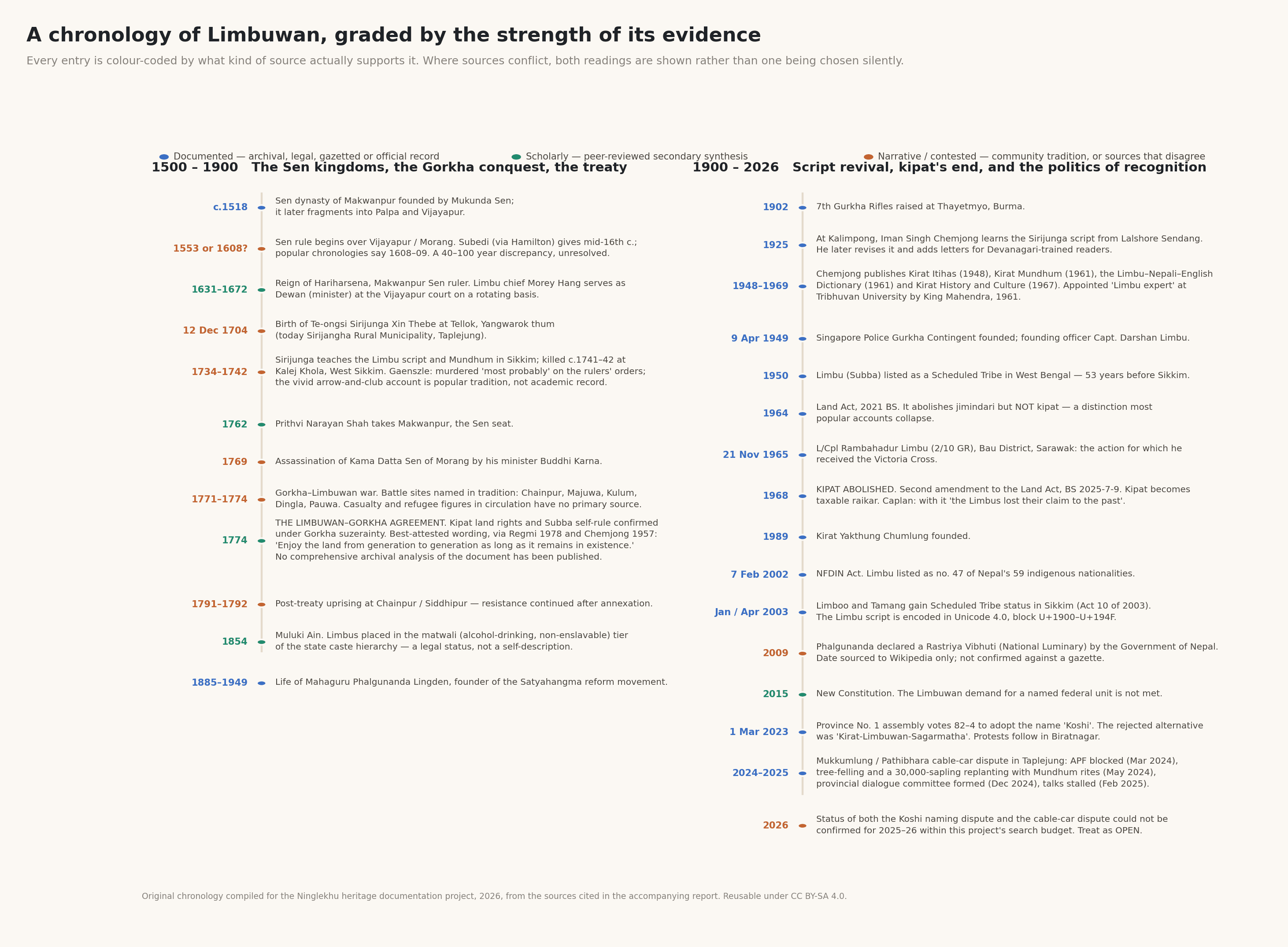
7. A chronology of Limbuwan, colour-coded by evidence grade.

Chronology
1500–1599
1600–1699
Reign of Hariharsena; Limbu chief Morey Hang serves as Dewan at Vijayapur
1700–1799
Birth of Te-ongsi Sirijunga Xin Thebe at Tellok, Yangwarok
Sirijunga enters Sikkim to teach the script and Mundhum
Sirijunga killed at Kalej Khola, West Sikkim
Prithvi Narayan Shah takes Makwanpur
Assassination of Kama Datta Sen of Morang by his minister Buddhi Karna
Gorkha–Limbuwan war
One source says the fighting lasted twelve years rather than three.The Limbuwan–Gorkha agreement; kipat and Subba self-rule confirmed
Post-treaty uprising at Chainpur / Siddhipur
1900–1999
7th Gurkha Rifles raised at Thayetmyo, Burma
Chemjong learns the Sirijunga script at Kalimpong
Chemjong’s major publications; TU appointment 1961
Singapore Police Gurkha Contingent founded
Limbu (Subba) listed as a Scheduled Tribe in West Bengal
Parliamentary bill to abolish kipat fails
Land Act abolishes jimindari — not kipat
Rambahadur Limbu’s Victoria Cross action, Bau District, Sarawak
Kipat abolished by the second amendment to the Land Act
Sikkim merges with India; the 1976 ST list excludes Limboo and Tamang
Kirat Yakthung Chumlung founded
2000–2099
NFDIN Act; Limbu listed no. 47 of 59 indigenous nationalities
Limboo and Tamang gain ST status in Sikkim (Act 10 of 2003)
Limbu script encoded in Unicode 4.0
Federal Limbuwan State Council founded — date contested
Joint Limbuwan Front formed
Phalgunanda declared Rastriya Vibhuti — date unverified
New Constitution; Limbuwan federal unit not created
Indian Supreme Court orders resolution of Limboo-Tamang seat reservation
Sikkim notification equating Limboo / Subba / Tsong / Yakthungba / Limbu
Province No. 1 assembly votes 82–4 to adopt “Koshi”; protests follow
Death of Captain Rambahadur Limbu VC, Lalitpur
Mukkumlung / Pathibhara cable-car confrontations, Taplejung
Renaming Joint Struggle Committee announces new agitation
Koshi provincial government forms dialogue committee
Pathibhara talks stall after two failed rounds
Status unknown — beyond the reach of the research behind this site
Sources for this page
Primary documentary
- A
- A
Government of Nepal (1964). Land Act, 2021 BS (1964) and its second amendment, BS 2025-7-9 (the abolition of kipat).
- A
- A
- A
Government of India (2003). Scheduled Castes and Scheduled Tribes Orders (Amendment) Act, 2002 (Act No. 10 of 2003).
- A
Government of Sikkim (2018). Notification No. GOS-32/SJE&WD/WD/2018, 27 August 2018.
- A
Unicode Consortium (2003). The Unicode Standard 4.0: the Limbu block, U+1900–U+194F; ISO 15924 code Limb (330).
Peer-reviewed scholarship
- B
Das, Basudevlal (2014). The Sena Dynasty: From Bengal to Nepal. Academic Voices 4.
- B
- B
- B
- B
Caplan, Lionel (1970). Land and Social Change in East Nepal: A Study of Hindu-Tribal Relations. Routledge & Kegan Paul, 1970; 2nd ed. 2000.
- B
Höfer, Andras (1979). The Caste Hierarchy and the State in Nepal: A Study of the Muluki Ain of 1854. 1979; 2nd ed. Himal Books, 2004.
- B
Encyclopedia of World Cultures — the entry on the Limbu.
- B
Gaenszle, Martin (2021). The Limbu Script and the Production of Religious Books in Nepal. Philological Encounters 6, nos. 1–2, Brill.
- B
Institutional or community publication
- C
- C
English Wikipedia articles on the Limbu people, History of Limbuwan, Limbu language, Limbu script, Te-ongsi Sirijunga Xin Thebe, Phalgunanda, Rambahadur Limbu, Kirat Mundhum, Chasok Tangnam, Sakela, Chyabrung, Kirat Yakthung Chumlung, Federal Limbuwan State Council, Religion in Nepal and Kiranti languages. English Wikipedia.
- C
The Kathmandu Post and Ekantipur: the Koshi naming vote (1 March 2023), the December 2024 dialogue committee, and the August 2026 indigenous-language digitisation report. Kantipur Media Group.
- C
Resurgence of Indigenous Movement in Nepal, 20 December 2024 (2024). Progressive International.
- C
Pathibhara cable-car negotiations, 27 February 2025 (2025). OnlineKhabar.
- C
Ninglekhu/ku heritage documentation project (2026). The Ninglekhu of Limbuwan: A source-critical history of a Yakthung clan, and of the people it belongs to. Ninglekhu/ku heritage documentation project (v1.0, 22 August 2026).
Twentieth-century Kirat historiography
- D
Chemjong, Iman Singh (1948–1974). Kirat Itihas (1948); Kirat Sahityako Itihas (1955); Kirat Folklore (1961); Kirat Mundhum (1961); Limboo–Nepali–English Dictionary (1961); Kirat History and Culture (1967); Kirat Darshanko Saransh (1969); Bijayapurko Itihas (1974).