The clan
Where we come from
No source places the Ninglekhu/ku in a thum, a khola or a village — so this page publishes the search that failed, and the structure the answer will fit into.
Where Ninglekhu/ku sits in the structure
No source places the clan within the tripartite Khambongba / Tangsangba / Munaphen classification Subba, Nawa Raj D, within the Lhasa-gotra / Kashi-gotra scheme, or within a specific thum Ninglekhu/ku heritage documentation project 2026 C. That is the honest state of the record, and it is why this page is shorter than it should be.
What can be shown is the architecture the answer will fit into: Limbu society is organised along two hierarchies at once — a territorial one running from Limbuwan down through thum and yok to the household, and a descent-based one running from the thar down to the sayepsa, those who share a father’s-side ancestor.
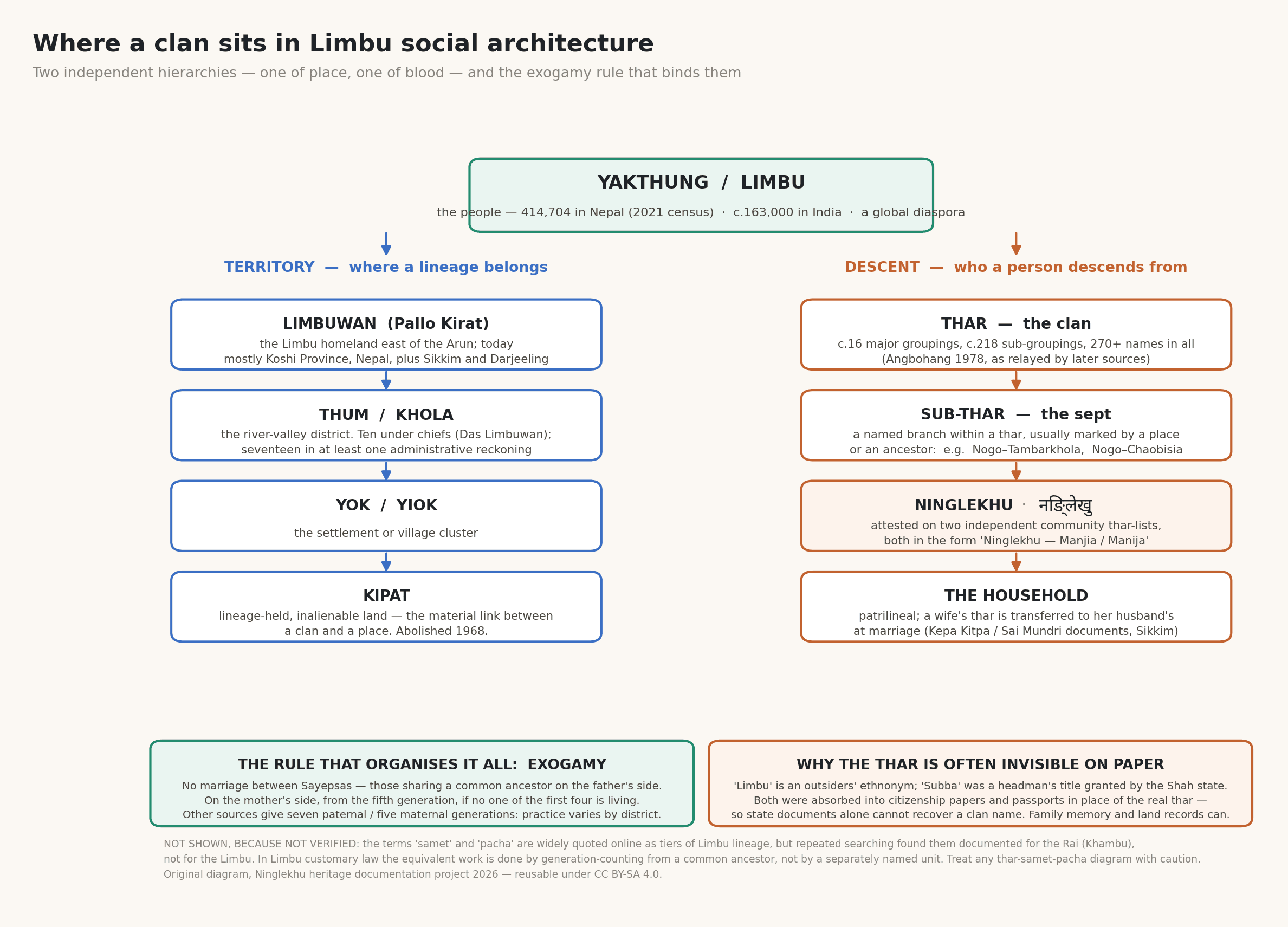
2. The two hierarchies of Limbu social organisation — territorial and descent-based — and the position of a clan within them.

Negative finding
CSamet and pacha are Rai terms, not Limbu ones
The terms samet and pacha circulate widely online as named tiers of Limbu lineage. Repeated searching found them documented for the Rai (Khambu) — a neighbouring but distinct Kirat people — and not for the Limbu. In Limbu customary law as recorded in Sikkim, the equivalent work is done by counting generations from a common ancestor rather than by a separately named unit. Any diagram presenting thar–pacha–samet as Limbu structure should be treated with suspicion Ninglekhu/ku heritage documentation project 2026.
This is a well-searched absence, not a proof.
The ledger of negative findings
Publishing what was not found is as important as publishing what was. This ledger tells a future researcher where not to spend their time, and tells a Ninglekhu/ku reader that the absences were looked for.
| Searched | Result |
|---|---|
| English Wikipedia, “Limbu clans and tribes” | Ninglekhu and all variants absent |
| English Wikipedia, “List of Limbu people” | No Ninglekhu entry |
| rishav-dahal.github.io “Cast in Nepal” master surname list | Absent, despite an otherwise thorough Limbu section |
| nrsubba.com.np, “Who are Limbu?” | Absent; the page gives classification, not a clan roll |
| NFDIN (Government of Nepal) Limbu page | No thar-level register exists on the page at all |
| Two Tribhuvan University e-library theses with clan enumerations | Ninglekhu absent from both |
| Place names — OSM/Nominatim, GeoNames, ward and VDC lists for Panchthar, Taplejung, Ilam, Terhathum, Dhankuta, Sankhuwasabha, Morang, Jhapa and Sunsari | No village, ward, hill or stream named Ninglekhu found in any spelling |
| Clan organisations — samaj, guthi, welfare societies — in Nepal, Sikkim, Darjeeling, Kalimpong, Hong Kong, the UK and Brunei | None found |
| Kipat documents, lalmohar, royal seals; Bhagiraj Ingnam’s 395-document collection (1662–1963) | The collection’s published summary names no clans; the volume itself was not searchable |
| Military records — Gurkha gallantry awards, Victoria Cross rolls | No Ninglekhu recipient found |
| Nepali politics — election candidate lists, party central committees | No Ninglekhu office-holder found |
| Devanagari news search for निङ्लेखु | One substantive result — the 2026 Ekantipur interview |
| forebears.io surname distribution | HTTP 403 — unresolved, not a negative; worth a manual retry |
| Sikkim and Darjeeling electoral rolls; SEE and NEB result lists; Nepal Army and Police rolls | Not reached before the search allowance ran out |
What would settle it
The record can be substantially improved, and most of the improvement will not come from archives Ninglekhu/ku heritage documentation project 2026 C. In descending order of expected return:
- Ask the elders about “Manjia”. One conversation may resolve what no amount of searching could.
- Collect the thar-to-thum mapping from families: which thum, which khola, which village. Ten interviews would produce a defensible geographic answer where, as of August 2026, zero sources exist.
- Photograph family documents. Old citizenship certificates, land papers, bansabali genealogies, army discharge papers, school certificates and letters are all primary sources — grade-A material sitting in tin trunks.
- Consult the Pangloss Limbu dictionary directly, from an ordinary browser rather than an automated fetch Pangloss Collection: the Limbu dictionary of the Mewa Khola dialect.
- Approach Kirat Yakthung Chumlung for the fullest published thar enumeration Kirat Yakthung Chumlung (Nepal), and Kirat Yakthung Chumlung UK.
- Retry forebears.io and, better, request surname-frequency data from the National Statistics Office directly National Statistics Office, Nepal 2021.
- Search the Regmi Research Series volume by volume for kipat and Subba records naming individual clans Regmi, Mahesh Chandra.
Ten families answering one question would give this page a geography. Which thum, which khola, which village do your people trace to?
Tell us which thumSources for this page
Primary documentary
Peer-reviewed scholarship
Institutional or community publication
- C
Ninglekhu/ku heritage documentation project (2026). The Ninglekhu of Limbuwan: A source-critical history of a Yakthung clan, and of the people it belongs to. Ninglekhu/ku heritage documentation project (v1.0, 22 August 2026).
- C
- C
- C
English Wikipedia articles on the Limbu people, History of Limbuwan, Limbu language, Limbu script, Te-ongsi Sirijunga Xin Thebe, Phalgunanda, Rambahadur Limbu, Kirat Mundhum, Chasok Tangnam, Sakela, Chyabrung, Kirat Yakthung Chumlung, Federal Limbuwan State Council, Religion in Nepal and Kiranti languages. English Wikipedia.