Research
How we know what we know
Every claim on this site carries a letter recording what kind of source stands behind it. This page explains the letters, and what was searched to earn them.
What the research set out to answer
The report this site is built on was constructed around six questions Ninglekhu/ku heritage documentation project 2026 C:
- What can be established about the Ninglekhu/ku thar specifically — its attestation, its place in Limbu clan classification, its geography, its etymology, and the people who carry the name?
- What is the wider Limbu history into which any single clan’s story has to be set — and which parts of it are documented rather than asserted?
- Where do the standard accounts disagree, and where does a widely repeated claim turn out to have no source behind it?
- What media and archival assets exist that a community website could lawfully publish?
- What methods should a clan use to generate the evidence that does not yet exist — oral history, genealogy, community archiving?
- What editorial standard would make such a site trustworthy to a family member, a school student, a journalist and a researcher at the same time?
Geographically the work covers the historic Limbuwan (Pallo Kirat) — today the eastern districts of Koshi Province — together with Sikkim and the Darjeeling–Kalimpong hills, and the global diaspora. Chronologically it runs from the classical attestation of the term Kirāta to developments recorded up to early 2025, with a note wherever the trail goes cold before the present day.
What was searched, and how
The research was run as a set of parallel, independently briefed enquiry streams, each instructed to record a verbatim quotation and a source URL for every claim and — crucially — to report failure explicitly rather than fill a gap with inference. The streams covered Ninglekhu/ku-specific evidence; Limbu ethnogenesis and Kirat historiography; the political history of Limbuwan; Mundhum, religion and script; social structure and customary law; modern demography and diaspora; and the media asset inventory. An eighth stream was tasked solely with attacking the gaps the first seven had left open. Roughly 550 distinct source retrievals were attempted Ninglekhu/ku heritage documentation project 2026 C.
The sources consulted include Nepal’s census reports National Statistics Office, Nepal 2021 Central Bureau of Statistics, Nepal and the NFDIN Act Government of Nepal 2002 A; NepJOL journals, Tribhuvan University theses, Dambar Chemjong’s Cornell dissertation Chemjong, Dambar Dhoj 2017, Martin Gaenszle’s articles Gaenszle, Martin 2021, population-genomic work in Current Biology, Scientific Reports, Human Genetics and Nature Communications, and the Sino-Tibetan etymological database Sino-Tibetan etymological database — the Limbu lexical dataset B; Ethnologue Limbu [lif], the Sikkim Tribal Research Institute Tribal Research Institute, Government of Sikkim and Kirat Yakthung Chumlung Kirat Yakthung Chumlung (Nepal), and Kirat Yakthung Chumlung UK C; and a range of community-compiled thar lists and heritage sites E.
Negative finding
CWhat could not be reached — named, so a later researcher knows where to go
- The Pangloss Collection’s Limbu dictionary returned HTTP 403 on every attempt, and remains the single most valuable unopened door for the etymological question Pangloss Collection: the Limbu dictionary of the Mewa Khola dialect.
- Internet Archive item pages were unreachable throughout — which also closed Weidert and Subba’s dictionary Weidert, Alfons, and Bikram Subba 1985.
- forebears.io surname-distribution pages returned 403.
- Wikimedia Commons file pages could not be fetched, so image licences are catalogued as “verify on the page” rather than asserted — and no such image is published here.
- The Regmi Research Series is downloadable volume by volume from Digital Himalaya, but its full-text search index at Cornell no longer exists Regmi, Mahesh Chandra.
- The monographs that matter most — Caplan Caplan, Lionel 1970, Sagant Sagant, Philippe 1996, Höfer Höfer, Andras 1979, Pradhan Pradhan, Kumar 1991, Rex Jones Jones, Rex L., Chaitanya Subba Subba, Chaitanya and Amrita Thebe Thebe, Amrita — were confirmed to exist but are not available in full text online.
Several claims on this site therefore rest on well-sourced secondary citation of those works rather than on the works themselves, and say so where they do. The research allowance was exhausted before the last stream finished; the open questions list what a follow-up pass should attack first.
The five grades
Every substantive claim carries a letter. The scheme is deliberately simple, and it is offered for reuse by other clan projects — copy it, or write your own, but use one and publish the key Ninglekhu/ku heritage documentation project 2026 C.
The evidence grades
Primary documentary
Legal instruments, gazettes, census tables, treaty text, official registers and inscriptions — the record itself rather than an account of it.
Peer-reviewed scholarship
University-press monographs, refereed journal articles and doctoral dissertations, where the argument has been read by other specialists.
Institutional or community publication
Reports and publications of governments, institutions and community organizations: reliable on their own activity, unrefereed on everything else.
Twentieth-century Kirat historiography
The foundational Kirat histories, written before modern source criticism and often citing no source at all. Indispensable, and not evidence on their own.
Oral tradition and uncurated compilation
Mundhum narrative, family memory and crowd-compiled thar lists. Testimony that the claim is held, not evidence of the fact asserted.
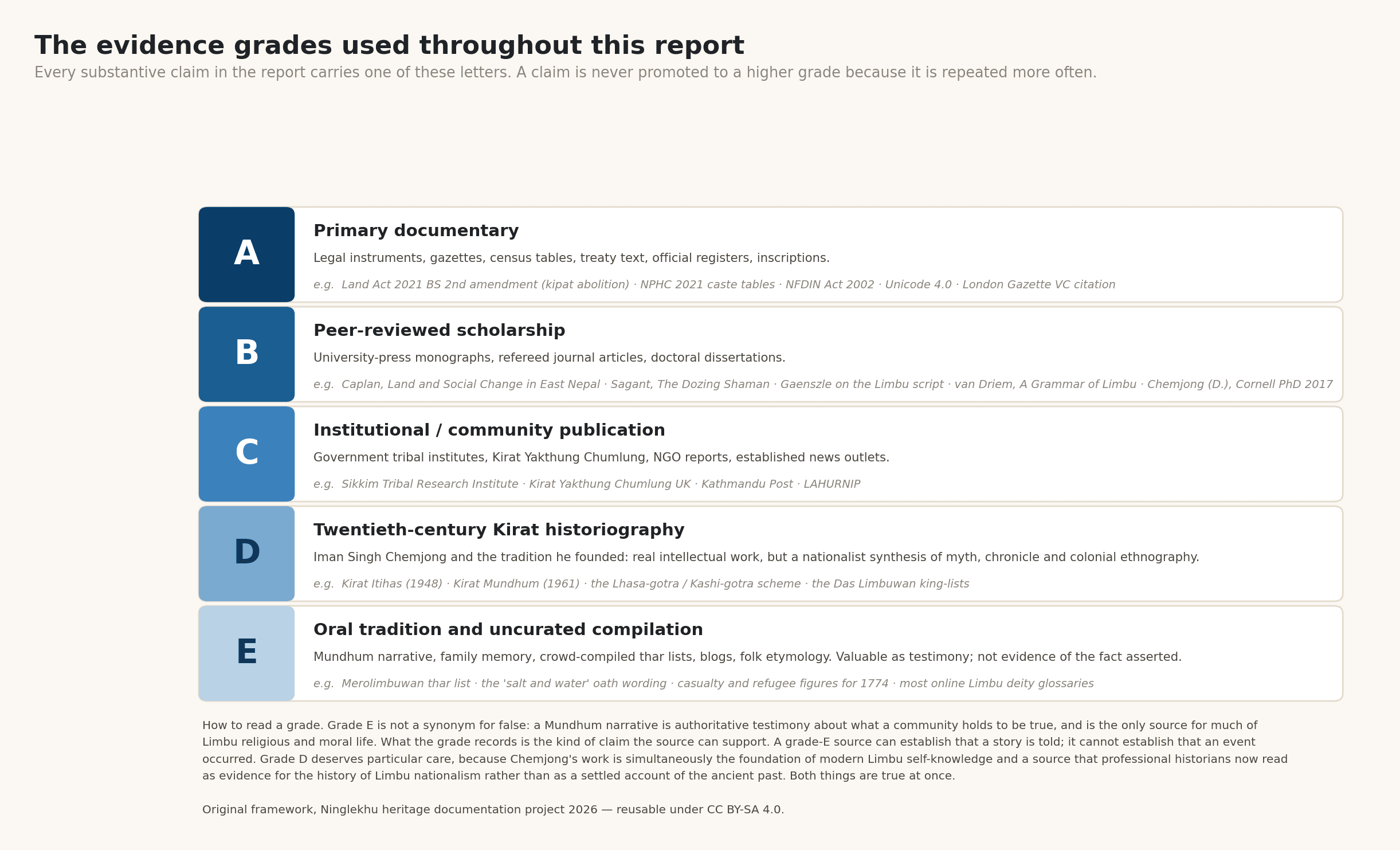
1. The five-grade evidence framework used throughout the report and this site.

What the grades do not say
The most important thing about the scheme is what it does not say. Grade E is not a synonym for “false.” A Mundhum narrative is authoritative testimony about what a community holds to be true, and it is the only source we have for most of Limbu religious and moral life. What the grade records is the kind of claim a source can carry: a grade-E source can establish that a story is told; it cannot establish that an event occurred. Both statements are worth publishing — but not in the same typeface, and not without saying which is which.
Grade D deserves particular care. Iman Singh Chemjong (1904–1975) is simultaneously the foundation of modern Limbu self-knowledge and a source that professional historians now read as evidence for the history of Limbu nationalism rather than as a settled account of the ancient past Chemjong, Iman Singh 1948–1974 D. Both things are true at once, and a clan website should be able to say so without embarrassment on either side.
Two further rules follow from the grades and are applied everywhere on this site. Repetition never promotes a claim: if forty websites say the same thing and none cites a document, the claim is still grade E. And anything current is date-stamped — “as of February 2025” is honest; “currently”, written in 2025, is quietly wrong by 2027.
Method
A closing note on method
The most useful thing this work can leave behind is not any particular fact about the Ninglekhu/ku. It is the demonstration that a clan history can be written to a real evidentiary standard — that you can say “this is documented,” “this is scholarship,” “this is what our elders tell us,” and “this we do not know,” all on the same page, without any of those four sentences weakening the others Ninglekhu/ku heritage documentation project 2026.
Sources for this page
Primary documentary
Peer-reviewed scholarship
- B
- B
Gaenszle, Martin (2021). The Limbu Script and the Production of Religious Books in Nepal. Philological Encounters 6, nos. 1–2, Brill.
- B
Sino-Tibetan etymological database — the Limbu lexical dataset. Starling (CNRS-linked).
- B
- B
Weidert, Alfons, and Bikram Subba (1985). Concise Limbu Grammar and Dictionary.
- B
Caplan, Lionel (1970). Land and Social Change in East Nepal: A Study of Hindu-Tribal Relations. Routledge & Kegan Paul, 1970; 2nd ed. 2000.
- B
Sagant, Philippe (1996). The Dozing Shaman: The Limbus of Eastern Nepal. Oxford University Press.
- B
Höfer, Andras (1979). The Caste Hierarchy and the State in Nepal: A Study of the Muluki Ain of 1854. 1979; 2nd ed. Himal Books, 2004.
- B
Pradhan, Kumar (1991). The Gorkha Conquests.
- B
Thebe, Amrita. Tumyang Judiciary System.
Institutional or community publication
Twentieth-century Kirat historiography
- D
Subba, Chaitanya. The Culture and Religion of Limbus.
- D
Chemjong, Iman Singh (1948–1974). Kirat Itihas (1948); Kirat Sahityako Itihas (1955); Kirat Folklore (1961); Kirat Mundhum (1961); Limboo–Nepali–English Dictionary (1961); Kirat History and Culture (1967); Kirat Darshanko Saransh (1969); Bijayapurko Itihas (1974).