The Limbu
Limbus today
The Limbu population is rising, its share of Nepal is falling, and the proportion who no longer speak Limbu has more than doubled in twenty years. All three are in the census.
Population
Two things are happening at once, and they pull in opposite directions. The absolute Limbu population is rising steadily — up 39% since 1991 — while the Limbu share of Nepal’s population is falling, from 1.63% to 1.42%, because the national population has grown faster National Statistics Office, Nepal 2021 Central Bureau of Statistics, Nepal A.
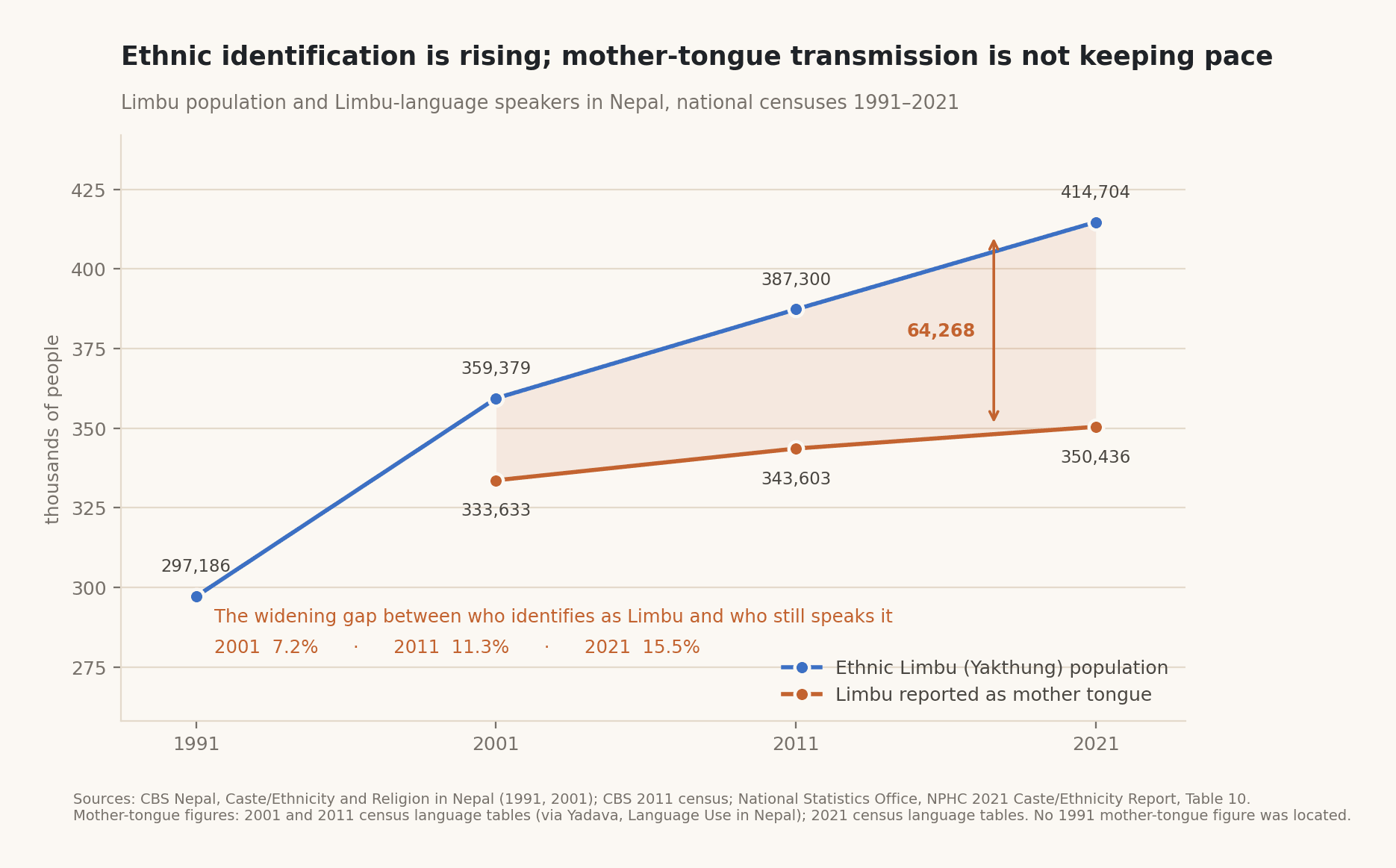
5. Ethnic Limbu population and Limbu mother-tongue speakers, Nepal censuses 1991–2021.

| Census | Limbu population | % of Nepal | Limbu mother tongue | Gap |
|---|---|---|---|---|
| 1991 | 297,186 | 1.63% | not located | — |
| 2001 | 359,379 | 1.58% | 333,633 | 25,746 (7.2%) |
| 2011 | 387,300 | 1.46% | 343,603 | 43,697 (11.3%) |
| 2021 | 414,704 | 1.42% | 350,436 | 64,268 (15.5%) |
Beneath both trends is a third: the proportion of ethnic Limbus who no longer report Limbu as their mother tongue has more than doubled in twenty years, from 7.2% to 15.5% Ninglekhu/ku heritage documentation project 2026 B. Ethnic identification is strengthening. Linguistic transmission is not.
Where Limbus live
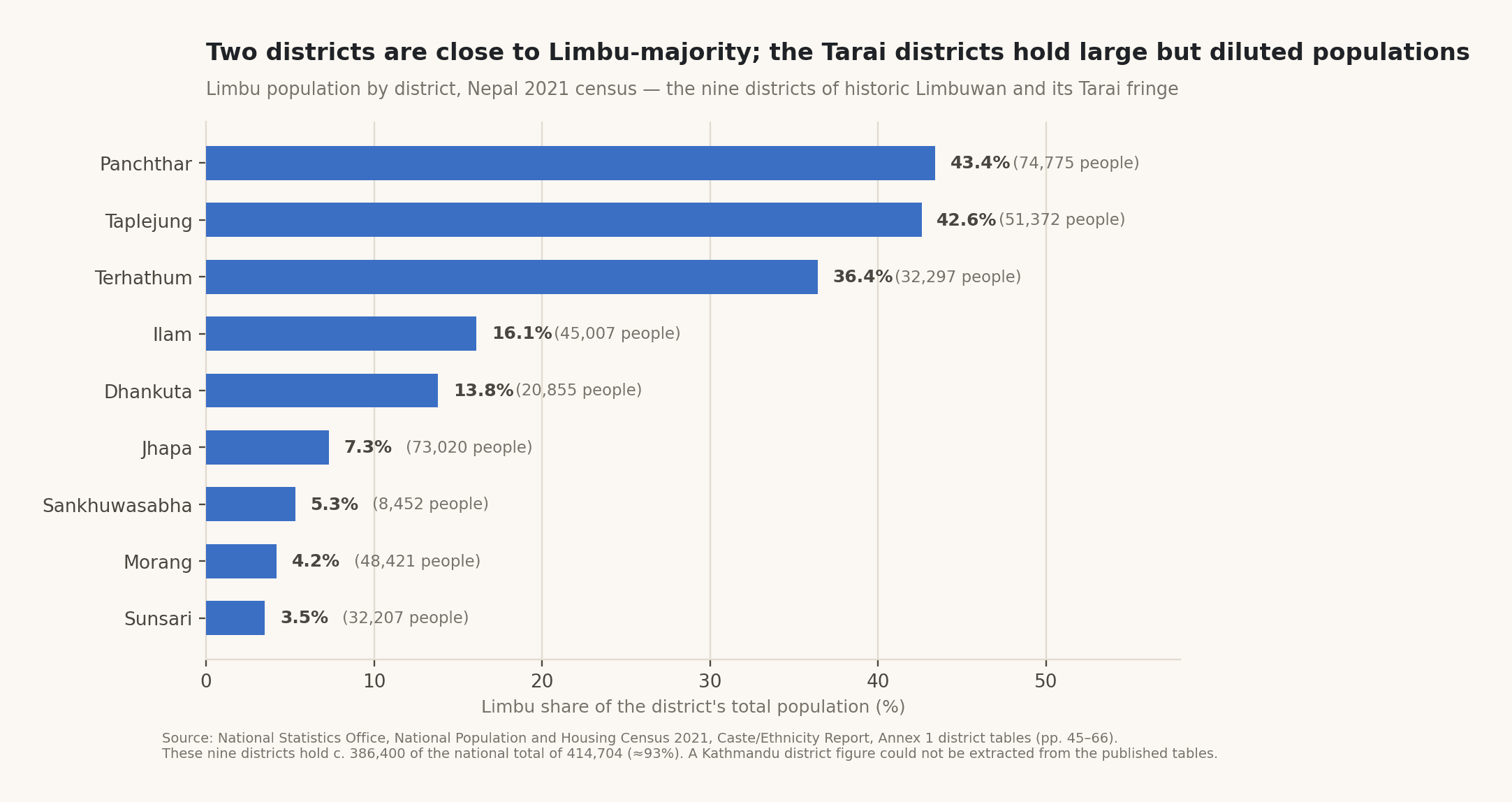
6. Limbu population by district, Nepal 2021 census.

| District | Limbu population | % of district |
|---|---|---|
| Panchthar | 74,775 | 43.4% |
| Taplejung | 51,372 | 42.6% |
| Terhathum | 32,297 | 36.4% |
| Ilam | 45,007 | 16.1% |
| Dhankuta | 20,855 | 13.8% |
| Jhapa | 73,020 | 7.3% |
| Sankhuwasabha | 8,452 | 5.3% |
| Morang | 48,421 | 4.2% |
| Sunsari | 32,207 | 3.5% |
The geography has two distinct patterns. Panchthar, Taplejung and Terhathum are the demographic heartland, where Limbus make up over a third of the population and Panchthar comes within seven points of an outright majority. Jhapa, Morang and Sunsari hold large absolute numbers in small percentages — the result of hill-to-Tarai migration into districts with much larger and more mixed populations. Jhapa’s 73,020 Limbus are almost as many as Panchthar’s, but they are 7.3% of their district rather than 43.4% National Statistics Office, Nepal 2021 A.
These nine districts hold roughly 386,400 people — about 93% of all Limbus in Nepal.
Negative finding
ARecognised as a nationality, and statistically invisible
A Kathmandu district figure could not be extracted from the published tables, which is a real gap given how much of the professional, literary and political Limbu community now lives in the capital National Statistics Office, Nepal 2021.
No Limbu-disaggregated data on literacy, education, income or human development could be found at all. The Nepal Living Standards Survey IV (2022/23) was fetched and searched in full and disaggregates only by province, urban/rural, quintile, sex and age — there is no Limbu row anywhere in it; the 2014 Population Monograph discusses only the largest groups National Statistics Office, Nepal 2023.
This is a documented absence, not an oversight, and it is worth naming as a policy problem: a group can be officially recognised as one of fifty-nine indigenous nationalities and still be statistically invisible in the surveys that drive policy.
Language shift and revitalisation
Ethnologue rates Limbu at EGIDS level 5, “Developing” — in vigorous use with a circulating literature, not yet fully standardised or institutionalised. It is not classed as endangered, and the assessment notes the language is “not replaced in any domain,” though younger generations increasingly use Nepali alongside it Limbu [lif] C.
Ethnologue’s dialect list — Panthare, Phedappe, Tamorkhole (Taplejunge), Chaubise (Charkhole), Chhatthare, Yanggrokke — maps directly onto the thum names of Limbuwan. Phedappe functions as something close to a prestige variety, “widely spoken and well understood by most Yakthungpan speakers” Limbu [lif] C.
What exists for revitalisation:
- Nepal has published “Ani Paan” textbooks in Limbu for grades 1 to 12 Ninglekhu/ku heritage documentation project 2026 C.
- Kirat Yakthung Chumlung teaches the language and the script on its own initiative Kirat Yakthung Chumlung (Nepal), and Kirat Yakthung Chumlung UK C.
- Tanchoppa (“Morning Star”) has published monthly since 1995 Ninglekhu/ku heritage documentation project 2026 C.
- Sikkim teaches the language in schools to over 4,000 students across twelve grades Ninglekhu/ku heritage documentation project 2026 C.
- The script has full free digital support — Unicode encoding and an open-licensed font — described on the script Ninglekhu/ku heritage documentation project 2026 A.
What does not exist: the Kathmandu Post reported on 22 August 2026 on Kathmandu University’s Information and Language Processing Research Lab, whose indigenous-language digitisation work focuses on Tamang, Nepal Bhasha and Rai — with Limbu mentioned in the context of official recognition in Koshi Province rather than as a target of the lab’s work. Professor Bal Krishna Bal’s framing is bleak and general: “English has become so dominant that we find it increasingly difficult to write and speak even in Nepali. The language faces ever more encroachment.” The language activist Bishnu Kumar Sinjali adds: “Technology has become essential to teaching the mother tongue to younger generations and ensuring its continuity” The Kathmandu Post and Ekantipur: the Koshi naming vote (1 March 2023), the December 2024 dialogue committee, and the August 2026 indigenous-language digitisation report C.
Open question
CUNESCO’s vitality rating for Limbu could not be retrieved
The World Atlas of Languages returned a server error throughout this research, so UNESCO’s own rating for Limbu is not reported here. The Ethnologue rating above is not a substitute for it Ninglekhu/ku heritage documentation project 2026.
The diaspora
Limbus are among the most internationally dispersed peoples in Nepal, for a specific historical reason: military service created migration routes that labour migration and family reunion later widened.
United Kingdom
The Gurkha settlement campaign is the defining episode. Reform on 8 March 2007 gave residency rights to those who had signed up after 1 July 1997 but excluded pre-1997 veterans. On 30 September 2008 Mr Justice Blake found the Home Secretary’s criteria “irrationally restrictive,” citing “historic injustice.” Joanna Lumley — daughter of a Gurkha major — led the Gurkha Justice Campaign; on 29 April 2009 the government was defeated in Parliament 267 to 246; and on 21 May 2009 Home Secretary Jacqui Smith announced that all Gurkha veterans who had retired before 1997 with at least four years’ service could settle in the UK. Lumley’s response: “This is the welcome we have always longed to give” Ninglekhu/ku heritage documentation project 2026 C.
The demographic consequence is visible in the census: 48,497 Nepal-born residents in England in 2011, rising to 77,349 in 2021, with 103,888 people of Nepali ethnicity in England and Wales at the 2021 census Ninglekhu/ku heritage documentation project 2026 C.
Town-level figures could not be extracted, but Kirat Yakthung Chumlung UK’s own branch list is arguably better evidence of where Limbus actually are: Ashford, Basingstoke, Berkshire, Canterbury, Colchester, Greater London, Folkestone, Greater London Senior, Doncaster, Oxford, Greater Rushmoor, Swindon, Thurrock, Wales, Warwickshire and West Kent — sixteen branches, with committee records going back to 2003 and an eleventh committee serving 2024–2027 Kirat Yakthung Chumlung (Nepal), and Kirat Yakthung Chumlung UK C.
Hong Kong
The Nepali community originates in the Brigade of Gurkhas garrison from the 1960s; after the 1997 handover and the brigade’s departure, Gurkhas and their children retained residence rights. The 2021 Population Census counted 29,701 Nepalese residents, up from 25,472 in the 2016 By-census. A conflicting figure of 18,094 for 2016 also circulates, apparently on a narrower nationality-based definition; it is flagged here rather than reconciled Ninglekhu/ku heritage documentation project 2026 C.
Elsewhere
United States: 219,503 people of Nepali descent at the 2020 census, up from 59,490 in 2010. Australia: 138,463 reporting Nepali ancestry in 2021, roughly doubling every five years since 2006. Japan: 273,229 Nepalis as of June 2025 per Ministry of Justice data, the largest South Asian community in the country. South Korea: 70,015 in 2013 under the Employment Permit System, following Nepal’s 2007 MoU — a figure now over a decade old. There is also substantial labour migration to Malaysia, Qatar, Saudi Arabia and the UAE Ninglekhu/ku heritage documentation project 2026 C.
Negative finding
CNone of the diaspora figures is Limbu-disaggregated
No country’s statistics break Nepali migrants down by ethnic group, so every number above counts Nepalis, not Limbus. Limbu-specific organisation abroad is best traced through Kirat Yakthung Chumlung’s chapters — the UK, Germany, Portugal, the USA, Japan, Hong Kong, South Korea, Australia, Israel, Kuwait, the UAE, Bahrain, Singapore, Malaysia, Cyprus and Qatar — which for a clan project is also the most efficient route to reaching families outside Nepal Kirat Yakthung Chumlung (Nepal), and Kirat Yakthung Chumlung UK Ninglekhu/ku heritage documentation project 2026.
Documented notable Limbus
The list below includes only individuals whose details were confirmed against a dedicated biographical source. A longer list circulates on Wikipedia; names from it that could not be independently confirmed are excluded here rather than repeated Ninglekhu/ku heritage documentation project 2026 C.
Politics
Rajendra Prasad Lingden (b. 7 September 1965, Amarpur, Panchthar) — Chairman of the Rastriya Prajatantra Party since 5 December 2021, when he won the leadership 1,844 to 1,617 against Kamal Thapa; Deputy Prime Minister and Minister of Energy, Water Resources and Irrigation, 17 January – 25 February 2023; MP for Jhapa-3, 2018–2025, having twice defeated the former Home Minister Krishna Prasad Sitaula. Indra Hang Subba — Lok Sabha MP for Sikkim (Sikkim Krantikari Morcha), elected 2019 and re-elected 2024; PhD in Physics, Sikkim University. Also documented: Sanchaman Limboo, fourth Chief Minister of Sikkim; Subas Chandra Nembang, former Speaker of Nepal’s House of Representatives; Govinda Subba, first Governor of Province No. 1 Ninglekhu/ku heritage documentation project 2026 C.
Military
Captain Rambahadur Limbu, VC, MVO — see History.
Literature and language
Bairagi Kainla, born Til Bikram Nembang Limbu (b. 9 August 1939) — poet, co-founder with Ishwar Ballav and Indra Bahadur Rai of the Tesro Aayam (“Third Dimension”) movement in Darjeeling in 1963, and Chancellor of the Nepal Academy from 2009 to 2013; recipient of the Sajha Puraskar, the Yuga Kavi Siddicharan Puraskar and the Jagadamba Shree Puraskar; now researches Limbu folklore Ninglekhu/ku heritage documentation project 2026 C. Iman Singh Chemjong (1 January 1904 – 1975) — historian, linguist, lexicographer and folklorist; author of Kirat Itihas (1948), Kirat Sahityako Itihas (1955), Kirat Folklore (1961), Kirat Mundhum (1961), the Limboo–Nepali–English Dictionary (1961), Kirat History and Culture (1967), Kirat Darshanko Saransh (1969), the Lepcha–Nepali–English Dictionary (1969) and Bijayapurko Itihas (1974); appointed “Limbu expert” at Tribhuvan University by King Mahendra in 1961 Chemjong, Iman Singh 1948–1974 D.
Sport
Kiran Chemjong, goalkeeper and captain of Nepal’s national football team; Anjila Tumbapo Subba, captain of the women’s national team; Saru Limbu and Laken Limbu, internationals; Pankaj Bikram Nembang, president of the All Nepal Football Association Ninglekhu/ku heritage documentation project 2026 C.
Academia and media
Tanka Bahadur Subba, former Vice-Chancellor of Sikkim University; Malvika Subba, media figure and activist, Miss Nepal 2002; Nabin Subba, film director; Deepak Limbu, Abhaya Subba, Jhuma Limbu and Tara Prakash Limbu in music Ninglekhu/ku heritage documentation project 2026 C.
Sources for this page
Primary documentary
Institutional or community publication
- C
Ninglekhu/ku heritage documentation project (2026). The Ninglekhu of Limbuwan: A source-critical history of a Yakthung clan, and of the people it belongs to. Ninglekhu/ku heritage documentation project (v1.0, 22 August 2026).
- C
- C
The Kathmandu Post and Ekantipur: the Koshi naming vote (1 March 2023), the December 2024 dialogue committee, and the August 2026 indigenous-language digitisation report. Kantipur Media Group.
- C
Twentieth-century Kirat historiography
- D
Chemjong, Iman Singh (1948–1974). Kirat Itihas (1948); Kirat Sahityako Itihas (1955); Kirat Folklore (1961); Kirat Mundhum (1961); Limboo–Nepali–English Dictionary (1961); Kirat History and Culture (1967); Kirat Darshanko Saransh (1969); Bijayapurko Itihas (1974).