Culture
The Sirijunga script
An abugida of sixty-eight assigned code points, a contested ninth-century origin, a teacher killed for propagating it, and — since 2003 — a solved technical problem.
What the script is
The Limbu — Sirijunga — script is an abugida of South Asian type, thought to have been inspired by the Lepcha script. Of the eighty code points in its Unicode block, sixty-eight are assigned: thirty base consonants and the vowel-carrier letter, nine vowel signs, three subjoined and nine small (final) letters, four signs, two punctuation marks and ten digits. Unicode Consortium 2003 A
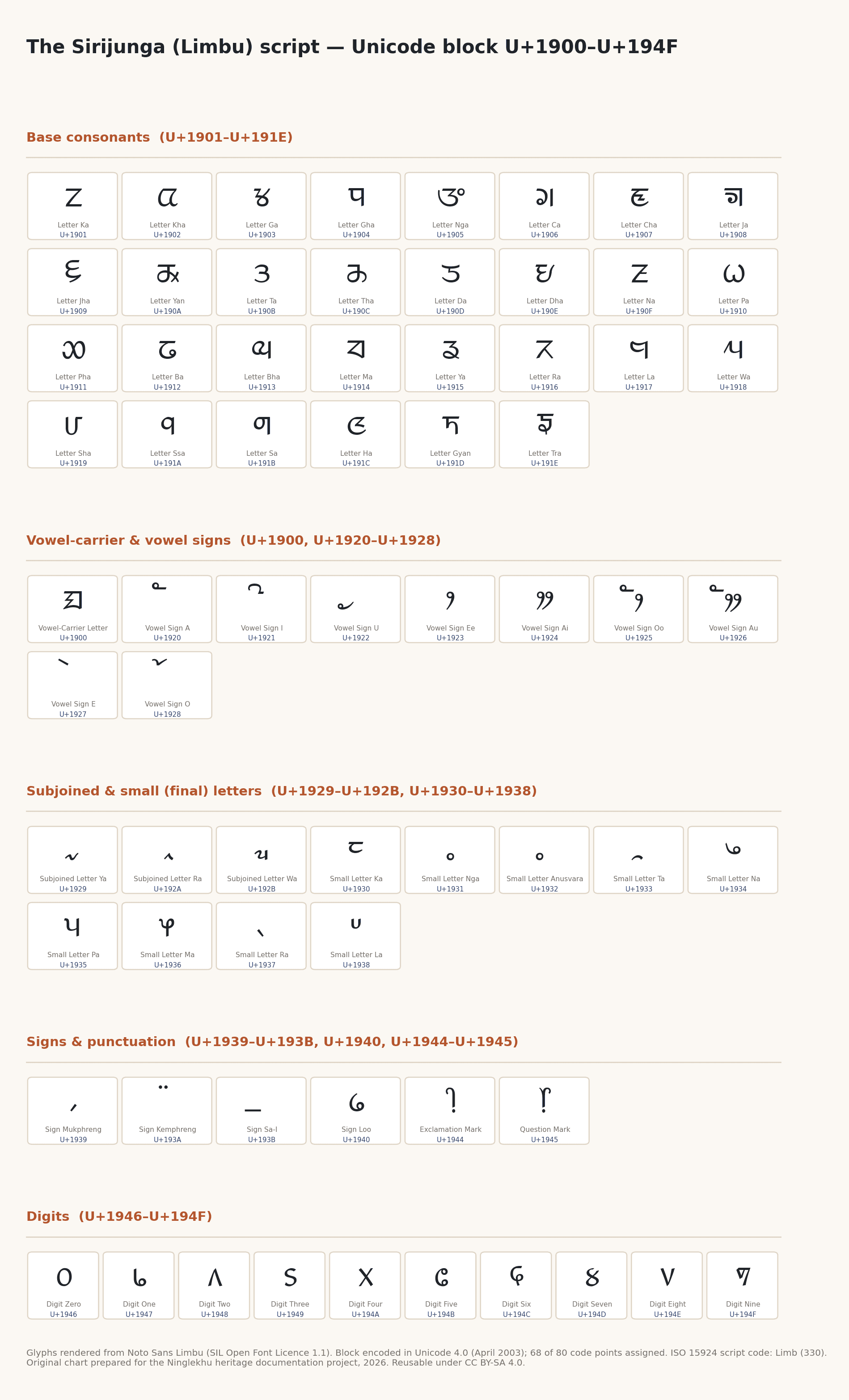
4. Figure 4. The Limbu (Sirijunga) script, Unicode block U+1900–U+194F, rendered from Noto Sans Limbu.

Contested
The two Sirijungas
This disagreement is published, not resolved. It is a clear case of state and community sources asserting as historical fact something the specialist literature treats sceptically, and a site that shows both — with attribution — is more trustworthy than one that picks either. Ninglekhu/ku heritage documentation project 2026
Tribal Research Institute, Government of Sikkim
CStates it as fact: “During the 9th century A.D., the king popularly called Srijunga Hang invented/devised a script of Limboo language now known as the ‘Srijunga Script’.” On this account the script was lost and then rediscovered and revived in the eighteenth century by Te-ongsi Sirijunga Xin Thebe. Tribal Research Institute, Government of Sikkim
Martin Gaenszle, *Philological Encounters* (Brill, 2021)
BOpenly sceptical: “the history of the Limbu script can be traced back to the eighteenth century, when Srijanga, a Limbu monk said to be affiliated with a monastery in Sikkim, began to propagate a Kiranti script.” Although local tradition holds that he discovered an ancient script, “historical evidence suggests it was original” — that is, Gaenszle reads the rediscovery narrative as a legitimating story attached to what was probably a new invention. Gaenszle, Martin 2021
Te-ongsi Sirijunga Xin Thebe
He was born on 12 December 1704 at Tellok, Kuchintar, in the Yangwarok thum — today Sirijangha Rural Municipality in Taplejung district, formed by merging eight former VDCs including Tellok. He entered Sikkim in 1734 to teach the script and the Mundhum, work that cut directly across the efforts of Buddhist lamas to convert Limbus and Lepchas. He was killed at Kalej Khola, Hee-Martam, West Sikkim, in 1741 or 1742. Ninglekhu/ku heritage documentation project 2026 C
Nepal Post has issued a stamp in his honour. Ninglekhu/ku heritage documentation project 2026 C
A chronology of the script
Tradition: King Sirijunga Hang devises the script
Asserted as fact by the Sikkim Tribal Research Institute; treated sceptically by Gaenszle. Held here as tradition, not as an established date.Te-ongsi Sirijunga Xin Thebe born at Tellok, Kuchintar
In the Yangwarok thum — today Sirijangha Rural Municipality, Taplejung district.He enters Sikkim to teach the script and the Mundhum
The teaching cut across the efforts of Buddhist lamas to convert Limbus and Lepchas.Killed at Kalej Khola, Hee-Martam, West Sikkim
The year is given as 1741 or 1742; the manner of his death is contested — see below.Lalshore Sendang teaches the script at Kalimpong
Iman Singh Chemjong was one of many Limbu youths who learned the Sirijunga script from him there.The Limbu block is encoded in Unicode 4.0
U+1900–U+194F; ISO 15924 script code Limb (330).
Contested
The manner of his death
The vivid execution detail is not corroborated academically and is presented here as tradition. That he was killed, and that the killing was political, is not in dispute. Ninglekhu/ku heritage documentation project 2026
Popular accounts, following Barun Roy, *Gorkhas and Gorkhaland* (2012)
CHe was tied to a tree, shot with poisoned arrows and clubbed to death by Bhutia soldiers. Ninglekhu/ku heritage documentation project 2026
Martin Gaenszle (2021)
BMuch more restrained: Sirijunga was “viewed as a separatist by the king of Sikkim” and “was murdered, most probably on the order of these rulers.” Gaenszle, Martin 2021
The twentieth-century revival
In 1925 the activist Lalshore Sendang visited Kalimpong, and Iman Singh Chemjong was one of many Limbu youths who learned the Sirijunga script from him there. Gaenszle records the consequence: “It was Iman Singh Chemjong (1904–1975), a young Limbu reformer and activist, who revised the Srijanga script and added a few letters to make it more compatible with Devanagari reading habits.” Gaenszle, Martin 2021 B
Book production in the script was driven above all by the Satyahangma movement. Gaenszle notes that “after Phalgunanda ‘discovered’ the Kiranti script, he fought not only for using the script, but also for introducing more systematic and widely available education,” and that “books in the Limbu script were produced in particular by followers of Phalgunanda.” Gaenszle, Martin 2021 B
Note
An object of veneration
Gaenszle makes an observation that any clan website ought to sit with: “the script itself has become highly esteemed, indeed has become as much an object of veneration as the content of the texts it is used for.” The script is not merely a writing system to the community that carries it; it is a sacred object in its own right, and that is why it is set large on this site and given space rather than reduced to data. Gaenszle, Martin 2021 B
Digital status, as of August 2026
The Limbu block was encoded in Unicode 4.0 in April 2003, at U+1900–U+194F; its ISO 15924 code is Limb (330). Noto Sans Limbu, under the SIL Open Font Licence 1.1, provides complete free coverage of the assigned code points and is production-ready for the web. Unicode Consortium 2003 Noto Sans Limbu A
Nepal has published “Ani Paan” textbooks in Limbu for grades 1 to 12, and Kirat Yakthung Chumlung teaches the script on its own initiative. Kirat Yakthung Chumlung (Nepal), and Kirat Yakthung Chumlung UK Ninglekhu/ku heritage documentation project 2026 C
The historical contrast is worth stating: “the use of the Limbu alphabet was banned and the possession of Limbu writings outlawed,” and the consequence — “far more Limbus are literate in Nepali than in Limbu in Nepal” — is still with us. Ninglekhu/ku heritage documentation project 2026 C
Method
How this site encodes Limbu
Every Limbu character on this site is real Unicode in the range U+1900–U+194F, set in Noto Sans Limbu. Legacy hacked fonts, which map Limbu glyphs onto Latin code points, are not used anywhere: text encoded that way is unsearchable, uncopyable and invisible to screen readers, and it is the main reason so little Limbu-script content is findable online.
Language and script are tagged explicitly — lang="lif-Limb" for Limbu in Sirijunga script, lang="lif" for romanised Limbu, lang="ne" for Nepali — and the font is served with a unicode-range descriptor so it downloads only on pages that actually contain Limbu text. Because there is no universal Limbu keyboard, the chart below doubles as a character picker for search boxes and contribution forms; no contributor is assumed to be able to type the script. Search indexes the romanised, Devanagari and Sirijunga forms of a term as synonyms. Ninglekhu/ku heritage documentation project 2026 Unicode Consortium 2003
The Limbu block, U+1900–U+194F
Consonants
Vowel signs
Subjoined letters
Small final letters
Signs
Punctuation
Digits
Reference chart — click a letter to copy it
| Claim | Grade | Source | Note |
|---|---|---|---|
| Sixty-eight of the block’s eighty code points are assigned. | A | Unicode Consortium 2003 | |
| The script was devised in the ninth century by King Sirijunga Hang. | C | Tribal Research Institute | Contested: Gaenszle treats the rediscovery narrative as a legitimating story. |
| The script’s history can be traced to the eighteenth century and was probably original to Srijanga. | B | Gaenszle 2021 | |
| Te-ongsi Sirijunga was born in 1704 and killed in 1741 or 1742. | C | Ninglekhu/ku heritage documentation project 2026 | |
| He was tied to a tree, shot with poisoned arrows and clubbed to death. | C | Ninglekhu/ku heritage documentation project 2026 | Tradition; not corroborated academically. |
| Iman Singh Chemjong revised the script and added letters. | B | Gaenszle 2021 | |
| Noto Sans Limbu covers the block under the SIL Open Font Licence 1.1. | A | Noto Sans Limbu |
Terms on this page
- Sirijunga (Srijunga)सिरिजङ्गाsirijaṅgā
The Limbu script — and also the name of two historical figures, whose relationship to one another is contested Gaenszle, Martin 2021 B.
- Mundhumमुन्धुमmundhum
The Limbu oral scripture: the body of recited narrative, genealogy, ritual instruction and moral teaching carried by ritual specialists. It is authoritative testimony about what the community holds to be true, which is a different thing from documentary evidence that an event occurred Limbu, Ramesh Kumar B.
- Thumथुमthum
A historic district of Limbuwan. Which thum a family belongs to is the geographic question this site is asking Ninglekhu/ku families to answer Ninglekhu/ku heritage documentation project 2026 D.
- Yakthungयाक्थुङyakthuṅ
The Limbu people’s own name for themselves, also Yakthumba and Yakthungba. “Limbu” is an exonym of uncertain origin that the state adopted and that Limbus now use as well Ninglekhu/ku heritage documentation project 2026 C.
Sources for this page
Primary documentary
Peer-reviewed scholarship
- B
Gaenszle, Martin (2021). The Limbu Script and the Production of Religious Books in Nepal. Philological Encounters 6, nos. 1–2, Brill.