Culture
Music and dance
Ya:lang is at once a harvest dance and the setting in which Limbus court; palam is the verse sung across it; the chyabrung is the drum that defines Limbu sound.
Ya:lang — the paddy dance
Ya:lang (Yalang, Yalakma), Dhan Nach in Nepali, is the central Limbu social dance: performed in a line or circle with interlocked hands and intricate synchronised footwork “depicting graceful movements of wild animals and birds.” It is simultaneously a harvest dance and the primary courtship setting — the two functions are not separable, and descriptions that keep only the first miss what the dance is for.
Ramesh Kumar Limbu’s “Ya:lang: An Intangible Limbu Cultural Heritage” (Contributions to Nepalese Studies 38:1, January 2011, CNAS, Tribhuvan University) is the dedicated academic treatment. Its existence and venue were confirmed for the report; the full text was not obtained. Limbu, Ramesh Kumar 2011 B
Palam — the sung poetry
Palam is the verse that accompanies Ya:lang: “a dialogue between the people i.e. male and female constructed with the question and answers patterns,” a song-duel of improvised call and response used “during important communal events, rituals and courtship.”
A 2025 study is honest about the limits of what is known: “Historical data related to origination of Palam is quite rare to prove in the century-based aspects.” The form is well described; its history is not. Limboo, Mugip Hang 2025 B
Ke:lang and the chyabrung
Ke:lang (Kelang) is the chyabrung dance, and the chyabrung (ke) is the instrument that defines Limbu sound: a two-headed cylindrical drum slung from the shoulder, one head struck with the palm (huksagay) for a sharp treble, the other with a stick called ke chari (singsagay / sinsagay) for a flat bass.
A 2025 peer-reviewed study frames it as “the complete mechanism for the Limbu world for maintaining governance among the insiders,” played at weddings, house inaugurations, Chasok Tangnam and death rituals. Dahal, Rai, Ghimire and Acharya 2025 B
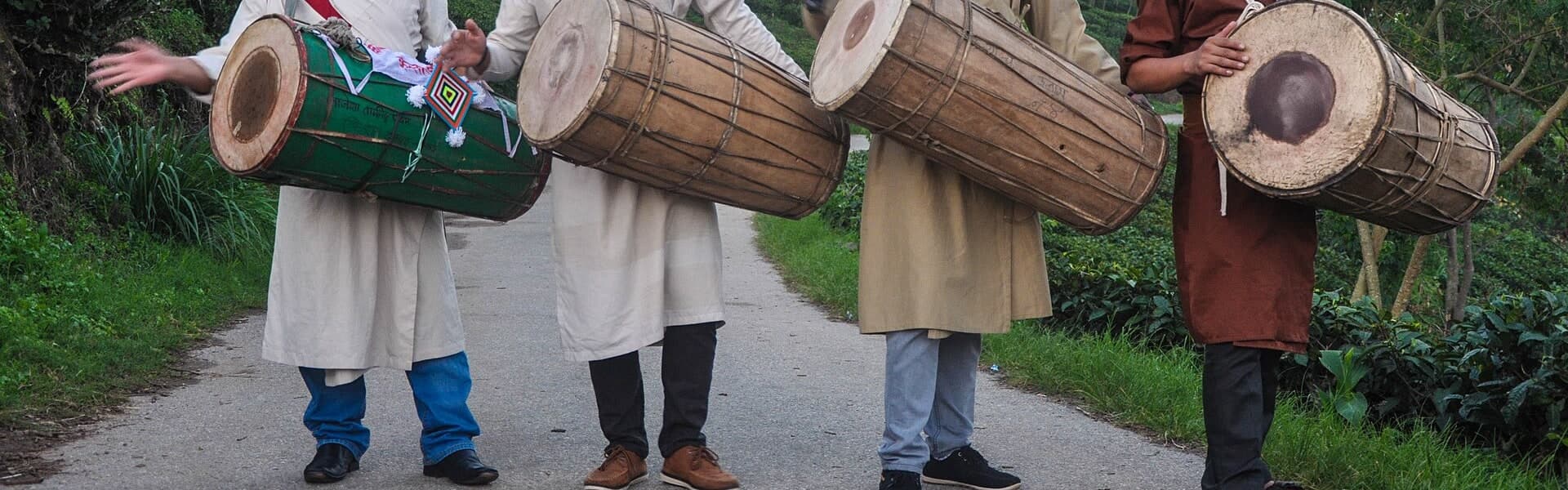
Four Chyabrung drums photographed in Ilam in 2016. The published detail is deliberately cropped to the instruments: it documents their two-headed cylindrical form without using the players as decorative subjects.

Contested
What the drum is made of
Both accounts use the same names for the two playing surfaces, so this is not a confusion of instruments. It is a genuine disagreement between a peer-reviewed source and the popular consensus, and it may reflect regional variation. Neither is silently chosen here. Ninglekhu/ku heritage documentation project 2026
Popular and community descriptions
EA body of hollowed wood, with cow skin on one face and bull or buffalo skin on the other. Ninglekhu/ku heritage documentation project 2026
Dahal, Rai, Ghimire and Acharya (2025), peer-reviewed
BA body of khamari wood (Gmelina arborea) “covered by goat skin from both sides.” Dahal, Rai, Ghimire and Acharya 2025
Other instruments
The literature also names the binayo and murchunga (jaw harps), the negra and the ponge. The fullest single treatment located is “Musical Instruments of Limbu in Sikkim” (International Journal of Current Research), which the report identified but did not fetch — so the list above is a list of names, not a description. Ninglekhu/ku heritage documentation project 2026 E
Negative finding
No UNESCO or Nepal government inscription was found
No UNESCO Representative List inscription, and no Nepal government intangible-heritage inscription, was found for any named Limbu practice. This is a negative finding from a non-exhaustive search — Nepal’s domestic inventory was not directly checked — but claims that chyabrung or Ya:lang are “UNESCO-recognised” should not be made without a citation, and none is made here. Ninglekhu/ku heritage documentation project 2026 C
| Claim | Grade | Source | Note |
|---|---|---|---|
| Ya:lang is both a harvest dance and the primary courtship setting. | B | Limbu 2011 | |
| Palam is improvised question-and-answer verse sung with the dance. | B | Limboo 2025 | |
| The origin date of palam cannot be established from available data. | B | Limboo 2025 | |
| The chyabrung is a two-headed drum, palm on one head, ke chari stick on the other. | B | Dahal 2025 | |
| The drum’s skin: goat on both sides (academic) versus cow and buffalo (popular). | B | Dahal 2025 | Contested — both positions are printed above, neither is resolved. |
| No UNESCO or Nepal intangible-heritage inscription for a Limbu practice. | C | Ninglekhu/ku heritage documentation project 2026 |
Terms on this page
- Ya:lang / Yalakmaया:लाङyā:lāṅ
The paddy dance (Dhan Nach): a linked line of dancers, and the setting in which palam is sung Limbu, Ramesh Kumar 2011 B.
- Palamपालामpālām
Sung question-and-answer poetry — courtship verse, improvised between two lines of singers Limboo, Mugip Hang 2025 B.
- Ke:langके:लाङke:lāṅ
The chyabrung dance Dahal, Rai, Ghimire and Acharya 2025 B.
- Chyabrung (ke)च्याब्रुङcyābruṅ
The two-headed Limbu drum, slung from the shoulder and struck on both faces — the instrument of the ke:lang Dahal, Rai, Ghimire and Acharya 2025 B.
- Chasok Tangnamचासोक तङ्नामcāsok taṅnām
The first-fruits harvest festival, kept at the Mangsir full moon: the new grain is offered to Yuma Sammang before it is eaten Ninglekhu/ku heritage documentation project 2026 C.
Sources for this page
Peer-reviewed scholarship
Institutional or community publication
- C
Ninglekhu/ku heritage documentation project (2026). The Ninglekhu of Limbuwan: A source-critical history of a Yakthung clan, and of the people it belongs to. Ninglekhu/ku heritage documentation project (v1.0, 22 August 2026).